Contents
Scroll to:
https://doi.org/10.47470/0869-7922-2026-34-2-150-156
EDN: oknnkf
Scroll to:
Introduction. Nitrogen dioxide is one of the most common anthropogenic air pollutants that initiates oxidative stress and an inflammatory response. In recent years, there has been increased interest in the use of acetylcysteine as a means of preventing and treating conditions accompanied by oxidative stress.
Material and methods. The aim of the study was to evaluate the protective effect of oral administration of acetylcysteine on the in rats exposed to long-term inhalation nitrogen dioxide. The protective effect of oral administration of acetylcysteine on the immunological profile and cellular composition of bronchoalveolar lavage fluid in rats during prolonged inhalation exposure to nitrogen dioxide was evaluated. Exposures to nitrogen dioxide (30–40 mg/m3) were carried out for 60 days (three times a day for 30 minutes with a half-hour interval between them). Every day, half an hour before exposure to nitrogen dioxide, the experimental group was administered a solution of acetylcysteine (50 mg/kg) through an esophageal tube, and the control group was administered a 0.9% sodium chloride solution. The cellular composition of bronchoalveolar lavage fluid, the content of pro-inflammatory mediators (TNF-α, IL-8), neutrophil elastase (NE), matrix metalloproteinase-12 (MMP-12), secretory immunoglobulin A (sIgA) and surfactant protein D (SP-D) were determined.
Results. Under the influence of 60-day exposure to nitrogen dioxide, the cytoimmunological profile of the bronchoalveolar space changed. The influx of neutrophils increased. The content of pro-inflammatory cytokines (TNF-α, IL-8) and proteases with destructive activity (NE, MMP-12) increased. The content of local immune defense markers (SP-D, sIgA) decreased due to a violation of the structural integrity of the bronchoalveolar epithelium. Daily oral administration of acetylcysteine for 60 days of nitrogen dioxide exposure contributed to the preservation of the basic structural and functional status of the lungs, which prevented the development of the inflammatory process and aberrant remodeling of lung tissue.
Limitations. the parameters of bronchoalveolar lavage fluid of animals were analyzed after exposure to nitrogen dioxide (30–40 mg/m3) for 60 days (three times a day for 30 minutes with a half-hour interval between them): the data obtained may differ under different experimental conditions.
Conclusion. The results show that acetylcysteine can serve as an effective prophylactic agent, preventing the negative consequences associated with lung exposure to the oxidative pollutant nitrogen dioxide.
Compliance with ethical standards. The experimental study was approved by the Independent Ethics Committee at the Kirov Military Medical Academy of the Ministry of Defense of the Russian Federation (Protocol No. 273, December 20, 2022), conducted according to the European Convention for the Protection of Vertebrate Animals used for Experimental and other Scientific Purposes (ETS No. 123), European Union Directive 2010/63 EU of 22.09.2010 on the protection of animals used for scientific purposes.
Authors contribution:
Preobrazhenskaya T.N. – conducting the experiment, data analysis, study design, article writing;
Lebedeva E.S. – conducting the experiment, data analysis, article writing.
All co-authors made significant contributions to the conception, conduct of the study and preparation of the article, and read and approved the final version before publication.
Conflict of interest. The authors declare that there are no conflicts of interest related to the publication of this article.
Funding. The study had no sponsorship.
Received: May 12, 2025 / Revised: March 04, 2026 / Accepted: March 27, 2026 / Published: April 30, 2026
Preobrazhenskaya T.N., Lebedeva E.S. Pneumoprotective effect of acetylcysteine during long-term exposure to nitrogen dioxide (experimental study). Toxicological Review. 2026;34(2):150-156. https://doi.org/10.47470/0869-7922-2026-34-2-150-156. EDN: oknnkf
Introduction
Air pollution is a serious public health problem [1, 2]. One of the most common anthropogenic air pollutants remains nitrogen dioxide, which is produced during various combustion processes, especially in industrial areas and megacities with heavy traffic, as well as during the detonation of explosives [3, 4]. In recent years, there has been increased research interest in the role of nitrogen dioxide not only as a component of complex air pollutant mixtures, but also as an independent risk factor for public health [5–8]. In epidemiological studies, changes in nitrogen dioxide levels are a reliable predictor of health risks and an indicator of air quality [9]. Exposure to nitrogen dioxide, even at low levels for short periods, impairs lung function. Prolonged exposure raises the risk of respiratory ailments (especially chronic obstructive pulmonary disease and bronchial asthma), irreversible lung damage, including pulmonary fibrosis, and mortality rates [10–13]. The potentiating effect of nitrogen dioxide on SARS-CoV-2 infection, which increases the risk of mortality, has been proven [14, 15]. Based on growing knowledge of the detrimental effects of nitrogen dioxide on human health, the World Health Organization reduced the annual airborne nitrogen dioxide exposure limit by 75% (from 40 µg/m³ to 10 µg/m³) in 2021 [7].
Nitrogen dioxide, as a free radical, acts as a powerful oxidant, triggering oxidative stress by generating excess reactive oxygen species. This process depletes the body’s antioxidant stores, intensifies the inflammatory response, and damages cells, primarily lung alveolar epithelial cells. In recent years, there has been an increased interest in the use of acetylcysteine, a mucolytic drug that has been known since the 1960s, as a potential treatment for many diseases and disorders associated with oxidative stress [16–18]. Acetylcysteine molecules can effectively neutralize reactive forms of oxygen and nitrogen, including nitrogen dioxide due to the presence of thiol groups [19]. However, clinical studies on the use of acetylcysteine for the treatment and prevention of a wide range of pathological conditions often give conflicting results, and experimental studies have mainly been performed in vitro [18].
The aim of this study was to evaluate the protective effect of oral administration of acetylcysteine on the immunological profile and cellular composition of the bronchoalveolar lavage fluid of rats exposed to long-term inhalation nitrogen dioxide.
Material and methods
The experiments were performed on male Wistar rats weighing 160–180 g (6–7 weeks old) bred at the Federal State Budgetary Institution “Rapolovo Laboratory Animal Nursery” of the Kurchatov Institute National Research Center (Vsevolozhsk District, Leningrad Region). The study was conducted in accordance with the European Convention for the Protection of Vertebrate Animals used for Experimental and other Scientific Purposes (ETS No. 123), Directive 2010/63/EU of 22 September 2010 of the European Parliament and of the Council on the Protection of Animals Used for Scientific Purposes, and was approved by the independent Ethics Committee of the S.M. Kirov Military Medical Academy of the Ministry of Defense of the Russian Federation (Protocol No. 273 of December 20, 2022).
The rats were kept in a room that met the hygienic requirements for keeping this species of laboratory animal (air temperature 20–26 °C, relative humidity 60–70%, 12-hour light/dark cycle). To perform inhalation priming with nitrogen dioxide, the rats were placed in a chamber connected to a laboratory nitrogen dioxide generator and mounted in an exhaust hood. A chemical reaction between sodium nitrite and sulfuric acid produced a mixture of nitrogen oxides, which was pumped through a discharge tube into the chamber containing the animals. When exposed to atmospheric oxygen, the colorless nitrogen oxide converted to the more stable yellow-brown dioxide. Gase mixture sampling from the chamber was performed through a special branch pipe at the beginning and end of the exposure to determine the nitrogen dioxide concentration, which was 30–40 mg/m³ (15–19 ppm). Monitored nitrogen dioxide levels in the chamber using a gas analyser. Inhalations were performed intermittently (three times a day for 30-minute, with half-hour intervals) for 60 days. Three groups of animals were formed to estimate the effect of oral acetylcysteine administration on the immunological profile and cellular content of bronchoalveolar lavage fluid.
1. Every day, 30 minutes before exposure to nitrogen dioxide, the experimental group of animals (n = 11) was administered with a freshly prepared acetylcysteine solution (ACC, Sandoz, Germany) in 0.9% sodium chloride solution (50 mg/kg body weight in 1.5 ml) through an esophageal tube.
Daily dose was calculated based on the dose of 600 mg recommended for chronic daily administration in humans, taking into account interspecies recalculation [20]. After oral administration, peak plasma concentrations are reached within 30 minutes to one hour [21].
2. Every day, 30 minutes before exposure to nitrogen dioxide, the control group of animals (n = 11) was administered with 1.5 ml of 0.9% sodium chloride solution per os to simulate intragastric administration.
3. The intact group of animals (n = 9) did not undergo any treatment (neither nitrogen dioxide exposure nor oral administration of drugs).
Animals were sacrificed using cervical dislocation. Immediately after euthanasia, the animal was placed on the operating table, the trachea was exposed through a midline incision and cannulated with a sterile catheter. Lungs were removed from the chest. Bronchoalveolar lavage performed on isolated lungs: 4 ml of sterile saline at room temperature were injected once into the lungs using a syringe, and repeated the procedure 4–5 times. Collected the freely flowing lavage fluid after each administration in a siliconized tube and centrifuged for 10 minutes at 1000 rpm. To determine the bronchoalveolar lavage fluid (BALF) cytogram in Romanovsky-Giemsa-stained smears, counted various cellular elements per 200 cells, and their percentage using light microscopy. Levels of tumor necrosis factor (TNF-alpha), interleukin-8 (IL-8), neutrophil elastase (NE), matrix metalloproteinase-12 (MMP-12), secretory immunoglobulin A (sIgA), and surfactant protein D (SP-D) in BALF samples were determined using species-specific ELISA kits of Cusabio Biotech (China).
Statistical data analysis was performed using Statistica 6.0 software package. Quantitative data presented as mean values (M) ± standard error (SE). The significance of the differences between the two compared values was determined using the Student’s t-test. The differences were considered as significant at p < 0.05.
Results
After 60 days of nitrogen dioxide exposure, the TNF-a content in the BALF of control rats increased by 2.3 times, and the IL-8 content by 2.4 times, compared with the intact group (p < 0.05) (Table 1). The neutrophil population in the BALF of the control group increased by 6.6 times (p < 0.05) (Table 2) compared with the group of intact animals, which could be due to increased production of IL-8, which has chemoattractant activity against neutrophils.
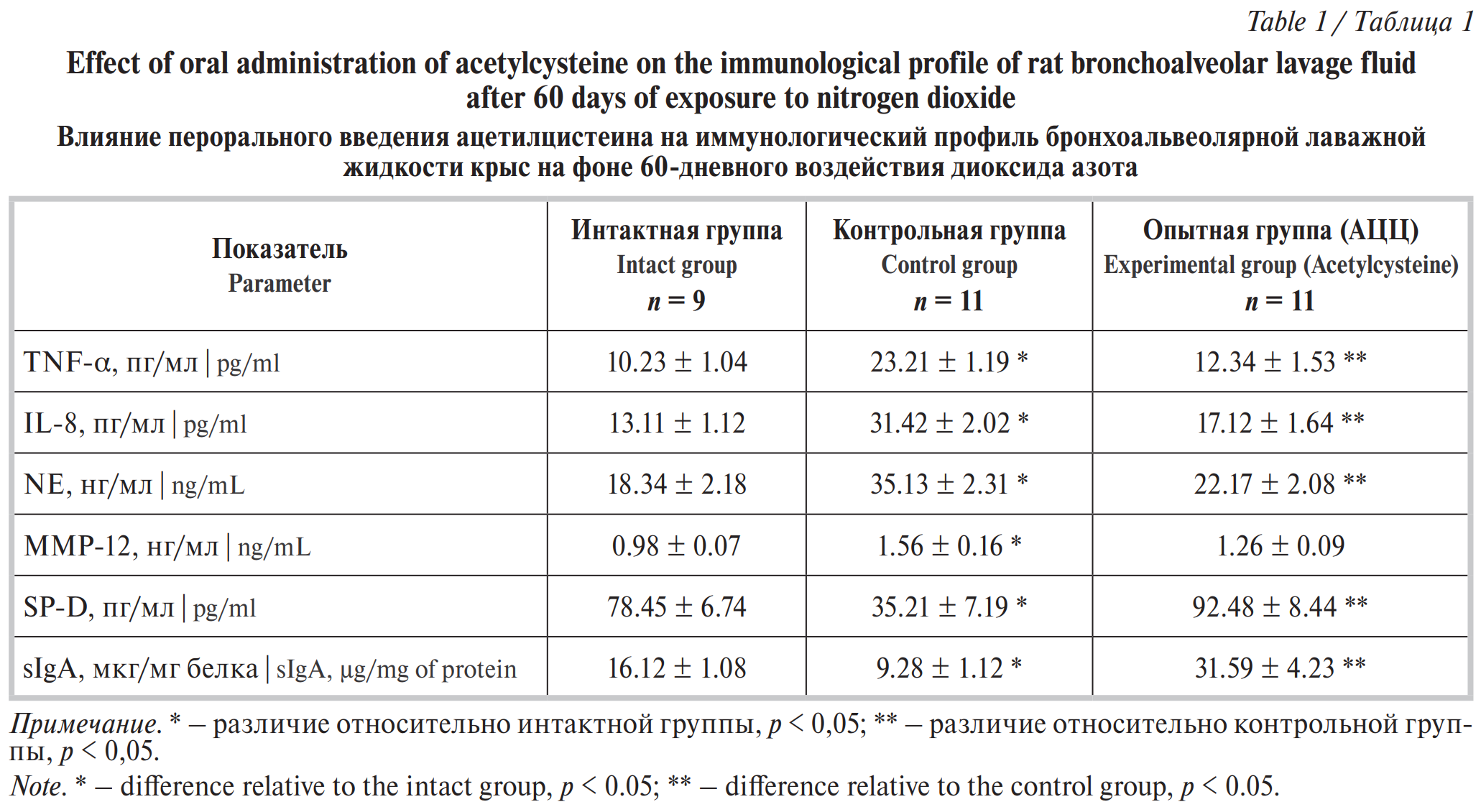
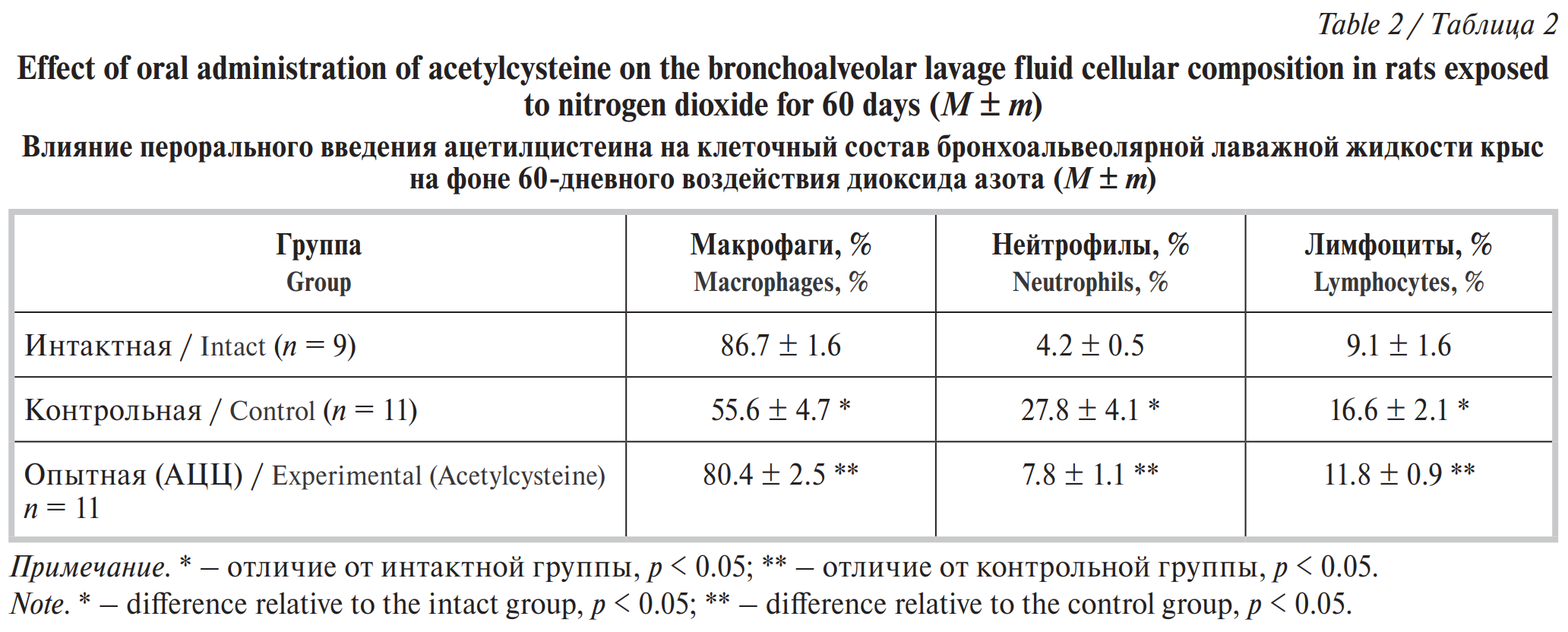
The elevation of neutrophils and a 1.8-fold increase in the lymphocyte population in BALF compared with control animals (p < 0.05) (Table 2) reflect the development of an inflammatory reaction in lung tissue. TNF-alpha and IL-8 induced secretion of neutrophil’s proteases to the extracellular space, including NE, the content of which in the BALF of the control group exceeded the value of this marker in the intact group by almost two times (p < 0.05) (Table 1). Activated alveolar macrophages and bronchial epithelial cells produce matrix metalloproteinase-12 (p < 0.05) (Table 1), which, like neutrophil elastase, has high catalytic activity with respect to elastin of the extracellular matrix of the lungs, which contributes to the degradation of the lung parenchyma and the formation of emphysema areas. MMP-12 can also activate the latent form of TNF-a on the surface of macrophages and thus enhance chronic respiratory inflammation. In case of activated inflammation in the BALF of control rats, the content of innate immune defense components-surfactant protein D and secretory IgA-decreased almost twofold compared to the intact group (p < 0.05) (Table 1).
Daily oral administration of acetylcysteine for 60 days of nitrogen dioxide exposure contributed to restoration of the BALF cytoimmunological profile. The content of TNF-a, IL-8, neutrophil elastase, and MMP-12 significantly decreased compared to the control (p < 0.05) and remained virtually unchanged from the corresponding values in the intact group (Table 1). The production of factors characterizing the state of local immune protection and functional integrity of the bronchoalveolar epithelium increased significantly. Thus, the SP-D content in the BALF of the experimental group of animals increased by 2.6 fold compared to the control group (p < 0.05) (Table 1). The secretory IgA content was 3.4 fold higher than in the control group (p < 0.05) (Table 1) and almost twice as high as in the intact group (p < 0.05) (Table 1). In the case of acetylcysteine administration, the cellular composition of the BALF returned to normal levels (Table 2). The percentage of neutrophils decreased significantly compared to the control (p < 0.05) (Table 2), although it remained slightly higher in comparison with the intact animals.
Discussion
Inhaled nitrogen dioxide can reach the level of the bronchioles and alveolar ducts and causes direct damage to the bronchoalveolar epithelium by reacting with substrates in the fluid of the mucous membrane of the respiratory tract. The resulting toxic oxidized compounds have a modulating effect on the alveolar population of cells — the effectors of inflammation — by changing their activation status and the profile of proinflammatory cytokines produced, thereby increasing the influx of inflammatory cells into the bronchoalveolar space. The most numerous immune cells on the surface of the bronchoalveolar epithelium are alveolar macrophages, which express and produce proinflammatory mediators in response to inhaled aggressive agents (TNF-a, IL-8, etc.) [22]. Exposure to nitrogen dioxide is associated with an increased permeability of the pulmonary epithelium due to the desquamation of epithelial cells with exposure of the basement membrane and disruption of intercellular tight junctions, which leads to the infiltration of neutrophils into the bronchoalveolar space [23, 24].
The most vulnerable and sensitive to nitrogen dioxide are type II alveolar cells, which are involved in surfactant synthesis and represent a pool of lung progenitor cells with high reparative potential [25]. A significant decrease in the content of surfactant protein D in the group of control rats could be associated with apoptosis of SP-D-secreting type II alveolar cells and nonciliary cells of the bronchioles (Clara cells) and leakage of SP-D into the systemic circulation through the inflamed or damaged alveolar-capillary membrane. Another important marker of local innate immunity is secretory IgA, synthesized by pulmonary plasma cells located on the surface of the respiratory epithelium. The decrease in sIgA content in the BALF observed after 60 days of nitrogen dioxide exposure is directly related to the disruption of the structural integrity and immune barrier function of the bronchoalveolar epithelium.
Despite numerous studies, the mechanisms by which acetylcysteine exerts its antioxidant, cytoprotective, and immunomodulatory properties remain unclear [16]. It is believed that, in addition to directly scavenging reactive oxygen species, it exerts an indirect antioxidant effect through its ability to replenish depleted glutathione stores, a key component of the lung’s antioxidant defense [26]. When administered orally, acetylcysteine is rapidly absorbed in the small intestine and diffuses into cells, where it is hydrolyzed to cysteine, which serves as a substrate for glutathione synthesis [25]. We have previously shown that due intermittent inhalations of nitrogen dioxide, the glutathione content in the lung tissue decreased by the 60th day of exposure by 56% relative to the baseline level (p < 0.05) [27]. Restoration of cytosolic and mitochondrial glutathione levels promotes the inactivation of reactive oxygen species, peroxynitrites, lipid peroxides and thus prevents cell damage. Some authors associate the pneumoprotective effect of acetylcysteine with the activation of the transcription factor Nrf2, which acts as a regulator of antioxidant, cytoprotective and detoxifying enzymes, representing a powerful cellular defense system, as well as with increased secretory activity of type II alveolar cells, which leads to increased surfactant synthesis [17]. Recently, an alternative mechanism has been proposed to explain the effects of acetylcysteine as a result of its conversion to hydrogen sulfide and sulfane forms of sulfur, which have antioxidant and cytoprotective properties [27].
Limitations of the study The parameters of bronchoalveolar lavage fluid of animals were analyzed after exposure to nitrogen dioxide (30–40 mg/m3) for 60 days (three times a day for 30 minutes with a half-hour interval between them). The data obtained may differ under different experimental conditions.
Conclusion
The bronchoalveolar epithelium serves as a protective barrier against inhaled aggressive pollutants. Damage to this barrier causes a disorganized immune response and increased inflammatory processes. Sixty-day exposure to nitrogen dioxide altered the cytoimmunological profile of the bronchoalveolar space in experimental animals: increased neutrophil influx, increased levels of proinflammatory cytokines (TNF-a and IL-8) and enzymes with proteolytic activity (NE and MMP-12), and decreased levels of local immune defense markers (SP-D and sIgA), due to disruption of the structural integrity of the bronchoalveolar epithelium. Daily oral administration of acetylcysteine for 60 days of nitrogen dioxide exposure contributed to restoration of the BALF cytoimmunological profile (TNF-a, IL-8, neutrophil elastase, and MMP-12), increased synthesis of local immune defense factors and functional integrity of the bronchoalveolar epithelium (SP-D, sIgA), and restoration of the BALF cellular composition. Thus, daily oral administration of acetylcysteine for 60 days of nitrogen dioxide exposure could contribute to the preservation of the structural and functional status of the lungs, prevent the development of inflammation, and prevent aberrant lung tissue remodeling. Acetylcysteine is a safe, inexpensive, and readily available substance and can serve as an effective prophylactic agent against the negative consequences associated with exposure of the lungs to the oxidative pollutant nitrogen dioxide.
1. Turner M.C., Andersen Z.J., Neira M., Krzyzanowski M, Malmqvist E, González Ortiz A., et al. Clean air in Europe for all! Taking stock of the proposed revision to the ambient air quality directives: a joint ERS, HEI and ISEE workshop report. Eur. Respir. J. 2023; 62(4): 2301380. https://doi.org/10.1183/13993003.01380-2023
2. Shetty S.S., Deepthi D., Harshitha S., Sonkusare S., Naik P.B., Kumari N.S., et al. Environmental pollutants and their effects on human health. Heliyon. 2023; 9(9): e19496. https://doi.org/10.1016/j.heliyon.2023.e19496
3. Bălă G.P., Râjnoveanu R.M., Tudorache E., Motișan R., Oancea C. Air pollution exposure – the (in)visible risk factor for respiratory diseases. Environ. Sci. Pollut. Res. Int. 2021; 28(16): 19615–28. https://doi.org/10.1007/s11356-021-13208-x
4. Perez-Lauterbach D., Nahum R., Ahmad H., Topeff J.M., Dossick D., Cole J.B., et al. Dose-dependent pulmonary injury following nitrogen dioxide inhalation from Kinepak™ detonation. J. Emerg. Med. 2019; 57(2): 177-80. https://doi.org/10.1016/j.jemermed.2019.03.028
5. Kravchenko J., Lyerly H.K. The impact of coal-powered electrical plants and coal ash impoundments on the health of residential communities. N. C. Med. J. 2018; 79(5): 289–300. https://doi.org/10.18043/ncm.79.5.289
6. Forastiere F., Peters A. Invited perspective: The NO2 and mortality dilemma solved? Almost there! Environ. Health Perspect. 2021; 129(12): 121304. https://doi.org/10.1289/EHP10286
7. Kephart J.L., Gouveia N., Rodríguez D.A., Indvik K., Alfaro T., Texcalac-Sangrador J.L., et al. Ambient nitrogen dioxide in 47 187 neighbourhoods across 326 cities in eight Latin American countries: population exposures and associations with urban features. Lancet Planet. Health. 2023; 7(12): e976–84. https://doi.org/10.1016/S2542-5196(23)00237-1
8. Mariscal-Aguilar P., Gómez-Carrera L., Carpio C., Zamarrón E., Bonilla G., Fernández-Velilla M., et al. Relationship between air pollution exposure and the progression of idiopathic pulmonary fibrosis in Madrid: Chronic respiratory failure, hospitalizations, and mortality. A retrospective study. Front. Public Health. 2023; 11: 1135162. https://doi.org/10.3389/fpubh.2023.1135162
9. Moshammer H., Poteser M., Kundi M., Lemmerer K., Weitensfelder L., Wallner P., et al. Nitrogen-dioxide remains a valid air quality indicator. Int. J. Environ. Res. Public Health. 2020; 17(10): 3733. https://doi.org/10.3390/ijerph17103733
10. Huangfu P., Atkinson R. Long-term exposure to NO2 and O3 and all-cause and respiratory mortality: a systematic review and meta-analysis. Environ. Int. 2020; 144: 105998. https://doi.org/10.1016/j.envint.2020.105998
11. Huang S., Li H., Wang M., Qian Y., Steenland K., Caudle W.M., et al. Long-term exposure to nitrogen dioxide and mortality: A systematic review and meta-analysis. Sci. Total Environ. 2021; 776: 145968. https://doi.org/10.1016/j.scitotenv.2021.145968
12. Meng X., Liu C., Chen R., Sera F., Vicedo-Cabrera A.M., Milojevic A., et al. Short term associations of ambient nitrogen dioxide with daily total, cardiovascular, and respiratory mortality: multilocation analysis in 398 cities. BMJ. 2021; 372: n534. https://doi.org/10.1136/bmj.n534
13. Chen X., Qi L., Li S., Duan X. Long term NO2 exposure and mortality: A comprehensive meta-analysis. Environ. Pollut. 2024; 341: 122971. https://doi.org/10.1016/j.envpol.2023.122971
14. Frontera A., Cianfanelli L., Vlachos K., Landoni G., Cremona G. Severe air pollution links to higher mortality in COVID-19 patients: The “double-hit” hypothesis. J. Infect. 2020; 81(2): 255–9. https://doi.org/10.1016/j.jinf.2020.05.031
15. Di Ciaula A., Bonfrate L., Portincasa P., Appice C., Belfiore A., Binetti M., et al. Nitrogen dioxide pollution increases vulnerability to COVID-19 through altered immune function. Environ. Sci. Pollut. Res. Int. 2022; 29(29): 44404–12. https://doi.org/10.1007/s11356-022-19025-0
16. Tenório M.C.D.S., Graciliano N.G., Moura F.A., Oliveira A.C.M., Goulart M.O.F. N-Acetylcysteine (NAC): Impacts on human health. Antioxidants (Basel). 2021; 10(6): 967. https://doi.org/10.3390/antiox10060967
17. Mokra D., Mokry J., Barosova R., Hanusrichterova J. Advances in the use of N-acetylcystein in chronic respiratory diseases. Antioxidants (Basel). 2023; 12(9): 1713. https://doi.org/10.3390/antiox12091713
18. Tieu S., Charchoglyan A., Paulsen L., Wagter-Lesperance L.C., Shandilya U.K., Bridle B.W., et al. N-Acetylcysteine and its immunomodulatory properties in human and domesticated animals. Antioxidants (Basel). 2023; 12(10): 1867. https://doi.org/10.3390/antiox12101867
19. Aldini G., Altomare A., Baron G., Vistoli G., Carini M., Borsani L., et al. N-Acetylcysteine as an antioxidant and disulphide breaking agent: the reasons why. Free Radic. Res. 2018; 52(7): 751–62. https://doi.org/10.1080/10715762.2018.1468564
20. Shekunova E.V., Kovaleva M.A., Makarova M.N., Makarov V.G. Dose selection in preclinical studies: cross-species dose conversion. Vedomosti Nauchnogo tsentra ekspertizy sredstv meditsinskogo primeneniya. 2020; 10(1): 19–28. https://doi.org/10.30895/1991-2919-2020-10-1-19-28 https://elibrary.ru/kvzbbv (in Russian)
21. Rushworth G.F., Megson I.L. Existing and potential therapeutic uses for N-acetylcysteine: The need for conversion to intracellular glutathione for antioxidant benefits. Pharmacol. Ther. 2014; 141(2): 150–9. https://doi.org/10.1016/j.pharmthera.2013.09.006
22. Aegerter H., Lambrecht B.N., Jakubzick C.V. Biology of lung macrophages in health and disease. Immunity. 2022; 55(9): 1564-80. https://doi.org/10.1016/j.immuni.2022.08.010
23. Dvorakovskaya I.V., Kuzubova N.A., Fionik A.M., Platonova I.S., Lebedeva E.S., Danilov L.N. Pathological anatomy of the bronchi and respiratory tissue of rats exposed to nitrogen dioxide. Pul’monologiya. 2009; (1): 78–82. https://elibrary.ru/kyutpl (in Russian)
24. Woodby B., Arnold M.M., Valacchi G. SARS-CoV-2 infection, COVID-19 pathogenesis, and exposure to air pollution: What is the connection? Ann. N. Y. Acad. Sci. 2021; 1486(1): 15–38. https://doi.org/10.1111/nyas.14512
25. Liu D., Xu C., Jiang L., Zhu X. Pulmonary endogenous progenitor stem cell subpopulation: Physiology, pathogenesis, and progress. J. Intensive Med. 2023; 3(1): 38–51. https://doi.org/10.1016/j.jointm.2022.08.005
26. Pedre B., Barayeu U., Ezeriņa D., Dick T.P. The mechanism of action of N-acetylcysteine (NAC): The emerging role of H2S and sulfane sulfur species. Pharmacol. Ther. 2021; 228: 107916. https://doi.org/10.1016/j.pharmthera.2021.107916
27. Kozlova M.Ya., Lebedeva E.S., Preobrazhenskaya T.N., Grebenjuk A.N. Activity of lipid peroxidation in the lung remodeling influenced by long-time intermittent exposure of nitrogen dioxide. Medline.ru. Rossiiskii biomeditsinskii zhurnal. 2011; 12: 301–10. https://elibrary.ru/pcaphz (in Russian)
Candidate of Biological Sciences, Associate Professor of the Department of Military Toxicology and Medical Protection, S.M. Kirov Military Medical Academy of the Ministry of Defense of the Russian Federation, Saint Petersburg, 194044, Russian Federation; Associate Professor of the Department of Anesthesiology and Intensive Care Medicine, Saint Petersburg State University, Saint Petersburg, 199034, Russian Federation
e-mail: tanapp@yandex.ru
Candidate of Biological Sciences, Leading Researcher at the Research Institute of Pulmonology, I.P. Pavlov First Saint Petersburg State Medical University of the Ministry of Health of the Russian Federation, Saint Petersburg, 197022, Russian Federation; Associate Professor of the Department of Anesthesiology and Intensive Care Medicine, Saint Petersburg State University, Saint Petersburg, 199034, Russian Federation
e-mail: osmelena@mail.ru
Preobrazhenskaya T.N., Lebedeva E.S. Pneumoprotective effect of acetylcysteine during long-term exposure to nitrogen dioxide (experimental study). Toxicological Review. 2026;34(2):150-156. https://doi.org/10.47470/0869-7922-2026-34-2-150-156. EDN: oknnkf
 Email this article (Login required)
Email the author (Login required)
Email this article (Login required)
Email the author (Login required) 8 build 2, Bagrationovsky proezd, 121087 Moscow, Russian Federation
Branch of «Russian Register of Potentially Hazardous Chemical and Biological Substances» FBES F.F. Erisman Federal Scientific Center of Hygiene of Rospotrebnadzor
tel.: +7 (499) 145 60 23 (reception)
e-mail: director@rosreg.info
фыв